

LED Grow Light Bars vs Quantum Panels: What Actually Changes?
The main difference between LED grow light bars and a Quantum Panel is emitting-surface geometry. Bars spread emitters across parallel rails, while a Quantum Panel places many diodes on a compact board.
That geometry affects footprint, diode spacing, and light overlap. Compare canopy size, hanging height, target intensity, wall draw, and the complete PPFD map.
How Do Bar-Style LED Grow Lights Distribute Light?
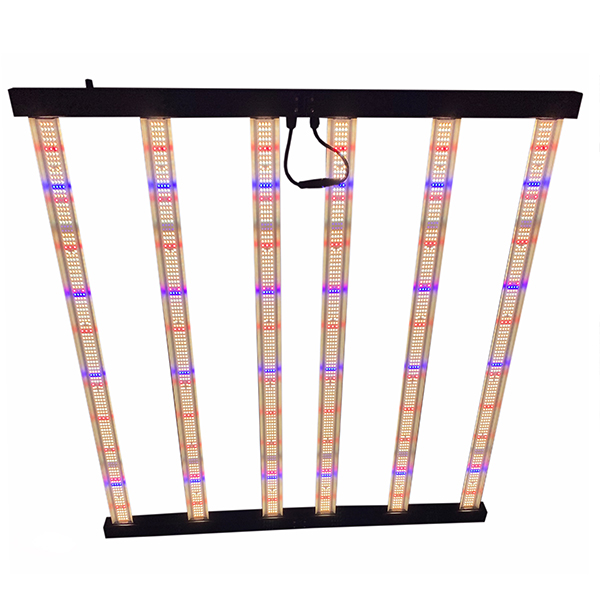
Bar-style Luz de crecimiento led create a distributed source across a wider footprint. Separated bars can place emitters closer to canopy edges, which suits wall-to-wall flowering areas and long benches.
The tradeoff is installation complexity. A multi-bar fixture may need more hanging points and clearance.
How Does a Quantum Panel Deliver Light to the Canopy?
A Quantum Panel uses densely arranged diodes on a flat emitting surface. It is a compact overhead fixture for a small grow tent, propagation area, seedling space, or regular plant group.
A compact LED panel is not automatically a poor coverage option. Board dimensions and hanging height determine the result. If the area is much larger than the board, the center may receive more light than the corners.
How Do LED Grow Lights and Quantum Panels Compare for Canopy Coverage?
For LED grow light coverage, distributed emitters often reduce center-to-edge differences across a large, flat canopy. A Quantum Panel may be more space-efficient over a compact canopy. Either can work when footprint and height match the area.
PPFD Uniformity: Compare the Center, Edges, and Corners
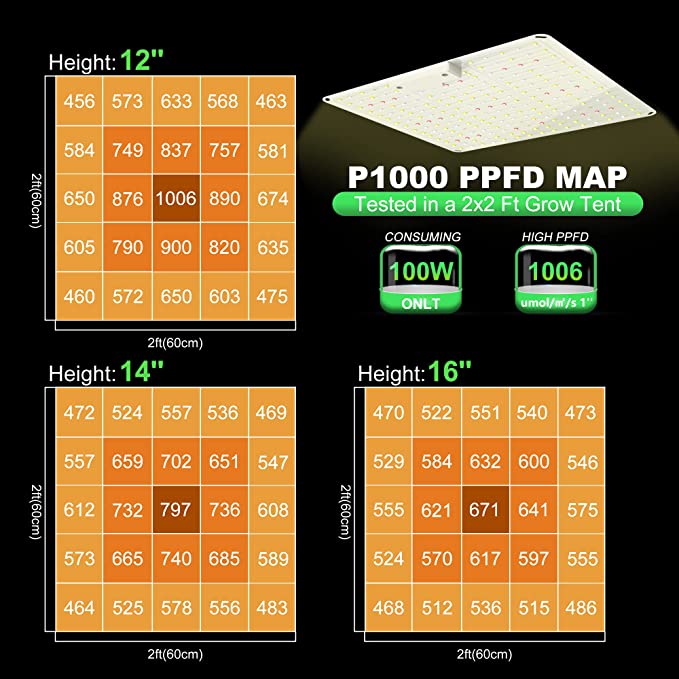
Do not compare fixtures by peak PPFD alone. Read center, edge, and corner values, then compare average and minimum readings. The minimum-to-average relationship shows whether plants receive much less light than the center.
Use the same test height and canopy dimensions for both fixtures. Distributed bars may reduce center and edge differences, but a Quantum Panel can also perform well.
How Do Hanging Height and Fixture Footprint Change Coverage?
Increasing LED grow light hanging height generally expands the footprint and lowers intensity. Lowering it raises intensity but can increase center-to-edge difference.
A bar fixture starts with a larger footprint, while a panel may fit neatly in a compact area. Compare maps at the same height and canopy boundary.
LED Grow Light Bars vs Quantum Panels: Heat and Installation
How Does Fixture Design Affect Heat Distribution and Airflow?
At the same wall draw, total heat remains tied to input power. Bars do not automatically produce less total heat than a Quantum Panel; the difference is distribution.
Bar structures spread heat-generating components over a wider area. A panel concentrates them, so heatsinking and airflow matter. Both designs can use passive cooling. TIDESTAR’s 35W/65W Quantum Panel kit includes passive fanless cooling, but that detail is model-specific.
Which Design Works Better for Clearance, Access, and Maintenance?
Check fixture dimensions, ceiling height, driver position, hanging hardware, and access around HVAC and irrigation. A broad multi-bar fixture may suit a commercial room but be awkward in a small tent.
Leave room to inspect wiring, adjust dimming, and remove a driver.
Which LED Grow Lights Fit Different Canopy Sizes and Use Cases?
When Does a Quantum Panel Fit Compact Grow Areas Better?
A Quantum Panel is often practical for compact grow tents, propagation, seedlings, vegetative areas, and smaller benches. It suits growers who value compact installation and is not limited to small grows.
The Samsung 100W LED Grow Light Quantum Plate for Veg Bloom has model-specific example coverage of 2.5 x 2.5 ft for vegetative growth at 18 in and 2 x 2 ft for flowering at 14 in. These figures apply only to that product.
When Do LED Grow Light Bars Make More Sense for Wide Canopies?
LED grow light bars tend to suit wide wall-to-wall canopies, four-by-four-foot or 5×5 areas, dense flowering plants, and commercial benches where uniformity matters more than peak center readings. This is a tendency, not a rule.
de TIDESTAR Samsung lm301B LED Grow Light 1000W Full Spectrum 5x5FT is a high-power fixture framed for a 5x5FT area. Its page wording includes 1000W, Samsung lm301B, and full spectrum; actual performance depends on the installed environment.
Can Multiple LED Grow Lights Improve Irregular Canopy Coverage?
Multiple LED grow lights can improve overlap across irregular benches or zones running different crop stages. Several Quantum Panels may fill corners more effectively than one oversized board.
This layout can improve scalability if electrical load, heat management, hanging capacity, and controls support expansion.
How to Choose Between LED Grow Light Bars and a Quantum Panel
Compare PPFD Maps, PPF, PPE, and Actual Power Draw
Use this order when choosing LED grow lights: canopy dimensions, target PPFD, PPFD map, PPF, PPE, actual wall draw, and mounting height. Then check center, edge, and corner values.
Wattage alone does not describe canopy performance. PPF describes total photon output, not where photons arrive. PPE describes efficiency, while wall draw determines electrical and heat load. Peak PPFD alone does not prove uniform coverage.
Match Canopy Size, Crop Stage, Budget, and Expansion Plans
Good LED grow light selection considers canopy area, crop stage, hanging height, HVAC capacity, fixture cost, electrical load, expansion, and service access. Compact growers may prioritize simple installation; commercial operators may prioritize repeatable coverage.
TIDESTAR manufactures and sells indoor plant-growing products. Its product scope includes LED grow lights, hydroponic systems, and other indoor growing equipment for hobbyists and commercial growers. Our product range can be judged by canopy geometry, not form factor alone.
Plants receive light information through photoreceptors, and spectral combinations can be designed around vegetative growth or flowering goals. Fixture geometry and spectrum should therefore be evaluated separately.
TIDESTAR LED Grow Lights and Quantum Panel Options by Use Case
LED Grow Light Bar Options for Wider Canopies
de TIDESTAR Barra de luz LED Samsung para horticultura y cultivo is a bar-style fixture example with dimming and full-spectrum page wording. Its distributed bar form can be used to discuss multiple emitting points and a wider physical footprint, while actual coverage and PPFD depend on installation, measurement, and crop response.
Quantum Panel Options for Compact Grow Areas
de TIDESTAR Samsung LED Grow Lights Panel 75W-480W for Indoor Plants is a full-spectrum, dimmable LED quantum panel family with 75W, 150W, 240W, 320W, and 480W entries. The 35W/65W Full Spectrum LED Quantum Grow Light Panel kit is described with dimmer control and passive fanless cooling. Match the model to the active canopy.
Preguntas frecuentes
Q: Are LED grow light bars better than a Quantum Panel for a four-by-four-foot grow tent?
A: Bars often suit a wide, flat canopy, but a Quantum Panel can work when its map, dimensions, height, and power match the four-by-four-foot area. Compare edge and corner PPFD.
Q: How high should LED grow lights and a Quantum Panel hang above the canopy?
A: Start with the manufacturer’s map, then adjust height and dimming while checking PPFD. Higher mounting usually widens the footprint; lower mounting usually increases intensity and contrast.
Q: Does a Quantum Panel provide enough edge coverage for flowering plants?
A: It can, if the panel footprint and height suit the flowering canopy. The named 100W Quantum Plate has a 2 x 2 ft flowering example at 14 in; other panels need their own map.
Q: Do bar-style LED grow lights run cooler than a Quantum Panel?
A: Not necessarily. At equal wall draw, total heat is tied to input power. Bars distribute heat; panels concentrate it and depend on heatsinking and airflow.
Q: Which LED grow lights work best for a dense commercial canopy?
A: A distributed bar fixture is a strong starting point for a wide, flat canopy where PPFD uniformity matters. A multi-panel layout can also work when overlap and expansion are planned.


