
At commercial scale, a light can be technically impressive and still be the wrong purchase. A few weak edges repeated across dozens of benches can become a crop-uniformity problem; excess heat can become a cooling problem; awkward access can become a labor problem. The useful question is not simply how many watts a fixture draws. It is whether the fixture delivers the intended light across the working canopy and remains practical for the room team to run.
Define the Light Target Before Comparing Fixtures
Set the canopy light target
Before opening a catalog, record the crop, stage, photoperiod, and production method. A propagation area and a flowering room may share the same building but not the same light target. Set the intended canopy PPFD, then calculate DLI from PPFD and operating hours. With those figures on paper, wattage becomes one input in the decision rather than the decision itself.
Request a PPFD map at the height you expect to use, not a generic laboratory image. Look at the average, the perimeter values, the measurement grid, and the area covered. A bright center with a falling edge can create more work than it saves: plants may need to be rearranged, or the whole fixture may be driven harder to compensate.
Calculate coverage and layout
Measure the crop area, not just the room. Benches, aisles, columns, wall setbacks, and maintenance lanes reduce the useful rectangle. Put the fixture dimensions, bar pattern, suspension points, and mounting range beside the bench drawing. In a multi-tier system, perform the exercise for each level; the lowest tier may see a different airflow pattern and a different amount of reflected light.
In practice, the strongest option is often the one that covers the full production rectangle with a sensible number of units. A small fixture count can make wiring easier, yet a modular arrangement may win on uniformity, spare planning, and zone-by-zone dimming. Make that trade-off against the way the room will actually be serviced.
Evaluate Spectrum, Efficacy, and Thermal Behavior
Read spectrum and dimming claims
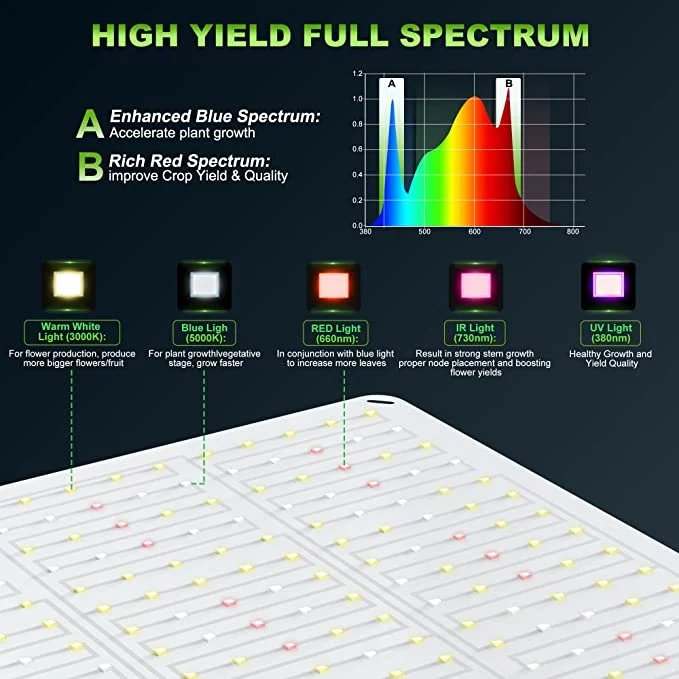
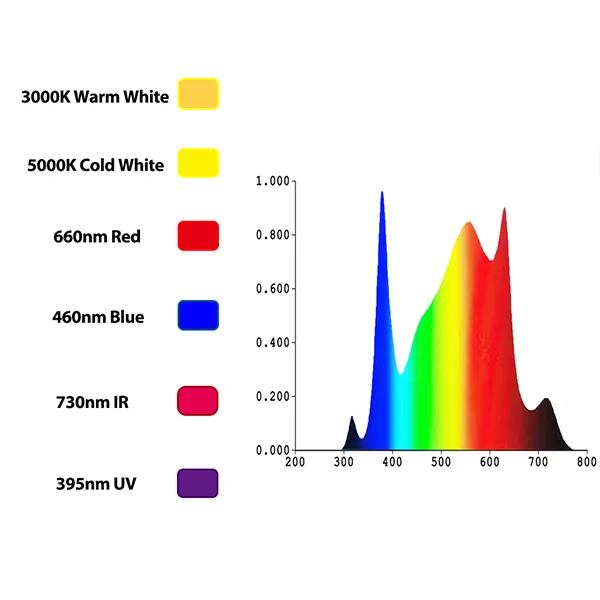
Treat “full spectrum” as a starting label, not a specification. Request the spectral chart and check which channels are present for the crop and stage. Find out whether white, red, far-red, UV, or other channels are controlled together or separately. Dimming has real value when one room serves more than one stage or when newly transplanted plants need a softer ramp-up.
The number that matters is useful light at the canopy, not the appearance of a marketing image. Compare PPE or efficacy in umol/J with the distribution map. A highly efficient fixture can still miss the room’s needs if the pattern is uneven. Also ask how the figure was measured: input power, operating temperature, and test position all affect the comparison.
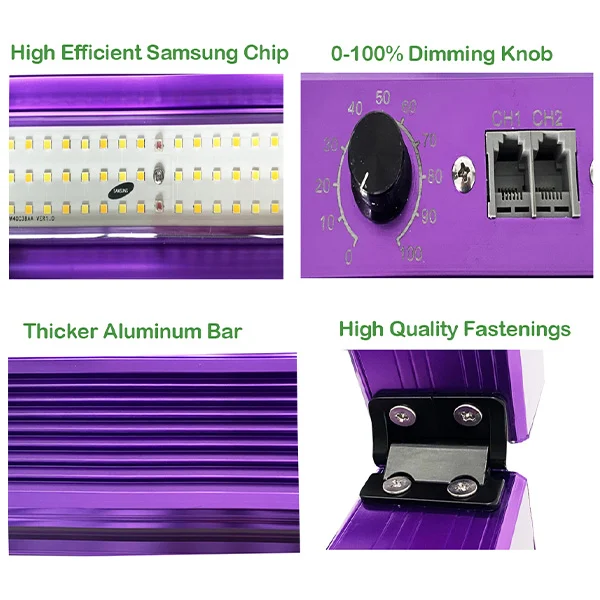
Check heat and environmental protection
LEDs can simplify heat management compared with older high-intensity systems, but the room still has to remove the heat produced by every powered watt. Check driver placement, the direction of heat release, passive or active cooling, clearance over the canopy, and how a technician will clean the fixture. IP protection deserves attention where irrigation, humidity, and condensation are routine conditions.
The TIDESTAR 1000W 4x6ft LED Grow Light uses Samsung LM301B and Osram LEDs, supports dimming, and directs heat upward away from plants. The same model is rated IP65 for damp environments and uses passive thermal management. These details help a buyer connect a product specification with the room’s cooling and maintenance plan.
Match the Fixture to the Operating Workflow
Compare control and maintenance needs
Controls should follow the operating routine. A single-stage room may need only reliable dimming, while a mixed-use facility may benefit from separate white, red, UV, or other channels. Check grouping, automation compatibility, and whether a proven setting can be copied to another room without commissioning everything from the beginning.
TIDESTAR supplies LED grow lights, hydroponic systems, and other equipment for indoor plant growth. Our team can review specifications, quantities, lead time, payment method, and shipping details before production. That service is useful when a commercial lighting order must be matched to a bench plan rather than selected as a standalone product.
Review installation and service
The purchase price is only one part of installation. Include lifting, suspension hardware, wiring, commissioning, cleaning, and eventual replacement. Confirm weight, included brackets or pulleys, input voltage, power factor, driver access, and the route a service person will use. A fixture that is easy to inspect may cost less over its working life even if its quotation is not the lowest.
For a new facility, a pilot bay is worth the time. Sample orders are welcome, and mixed samples are acceptable. Sample orders typically take 4-5 days, while mass production takes 20-35 days. A trial lets the installer check suspension, wiring, distribution, and access before the same decision is repeated across the whole room.
Compare Commercial LED Grow Lights With Evidence
Evaluate a 1000W 4x6ft fixture
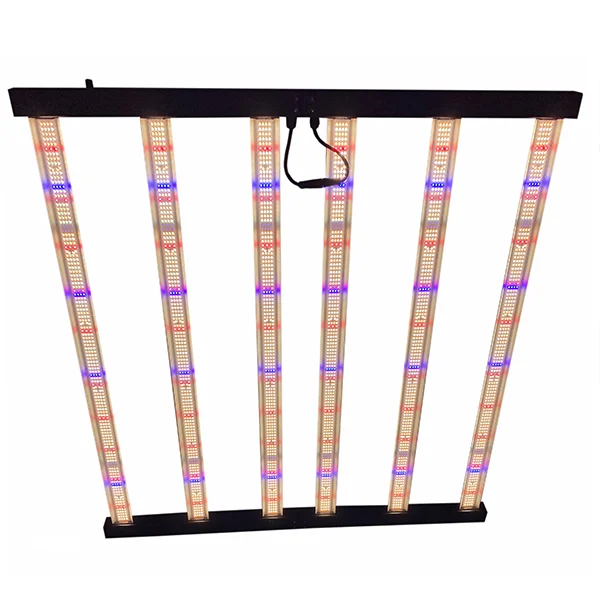
The 1000W 1200W 1400W 4x6FT LED Grow Lights Samsung lm301B Full Spectrum Lamp is built around a 4 x 6 ft coverage area. The knowledge-base specification lists 1000W, 1200W, and 1400W power options, 12 bars, 3000K and 5000K white chips with Osram 660 nm red chips, 120-240V input, passive thermal management, and a mounting height of at least 15 cm above plant tips. Treat those figures as a starting comparison, then check the current PPFD map against the actual bench.
Evaluate a 1000W 5x5ft fixture
The 1000w Full Spectrum 5x5ft Samsung lm301H Foldable Plant LED Grow lights suits a more compact 5 x 5 ft growing space. Its listed efficacy is up to 3.34 umol/J, with 3000K, 5000K, and 660 nm elements, dimming, passive thermal management, and a 120-240V input range. Folding can make handling simpler, but it does not replace a canopy-level uniformity check.
Evaluate an 800W adjustable fixture
The 800w LM281B LED Grow Light 5x5ft Full Spectrum 2 Channels Dimming With UV IR adds two-channel dimming and a spectrum that includes Samsung LM281B, 660 nm red, 395 nm UV, 730 nm IR, and 460 nm blue light according to the product information. The listed input range is 110-277V, cooling is passive, and the listed lifetime is above 50,000 hours. It is worth considering where stage-to-stage adjustment matters, but the control plan should be tested with the crop rather than assumed from the feature list.
Build a Purchase Checklist
Confirm performance documents
Before issuing a purchase order, place the data sheet, PPFD map, spectral chart, test conditions, power draw, input range, control method, IP rating, warranty, and spare-part policy in one comparison file. Check the model name and document revision. If two efficacy figures disagree, resolve the difference before ranking the quotations.
Check lifecycle support
A commercial lighting decision also covers the years after commissioning. TIDESTAR lists a 1-5 year warranty and provides technical service for future questions. Record the commissioning contact, the evidence required for a quality claim, and the process for matching a replacement fixture to the installed spectrum and layout.
The LED product line is designed for a long use life, typically rated at 90% of initial output at 35,000 hours. Its long use life is linked to the thermal properties of the fixture and the quality of the power units.
FAQ
Q: How do I choose LED Grow Lights for a commercial room?
A: Start with the crop’s PPFD and DLI target. From there, compare the canopy map, spectrum, efficacy, heat burden, controls, installation work, and service plan.
Q: Is higher wattage always better for commercial cultivation?
A: No. Extra output is not useful if the edge of the canopy remains weak or the electrical and cooling systems cannot support the load comfortably.
Q: What should a commercial LED Grow Light PPFD map show?
A: Check the measurement grid, mounting height, operating power, average PPFD, edge readings, and stated coverage. Those details make the supplier’s map comparable with the real bench.
Q: Are full-spectrum LED Grow Lights suitable for different growth stages?
A: They can. The spectrum and intensity still need to suit the crop, and the fixture should offer enough adjustment for the transition between stages.
Q: How often should commercial LED Grow Lights be checked?
A: Inspect fixtures and connections as part of routine maintenance, remove dust or residue when needed, and check output after recommissioning or whenever the crop response changes.