
Wattage of an LED Grow Light is the electrical power it draws in watts. This number does not give any indication of the amount of photosynthetically active light that is delivered to the canopy. This is affected by the efficacy of the fixture, the optics, the layout of the diodes, the efficiency of the driver, the height at which the light is mounted, and whether or not it is being dimmed. The wattage of a grow light is used for electrical planning purposes only.
Separate Electrical Watts from Plant Light
Separate Draw from Photon Output
We choose the wattage of our canopy light after we have established the area to be lit, the required light and the mounting height. The wattage is indicated on the light fitting but the power label does not tell you whether you have sufficient light in the corners or whether the room can remove the additional heat produced.
Compare Like-for-Like Measurements
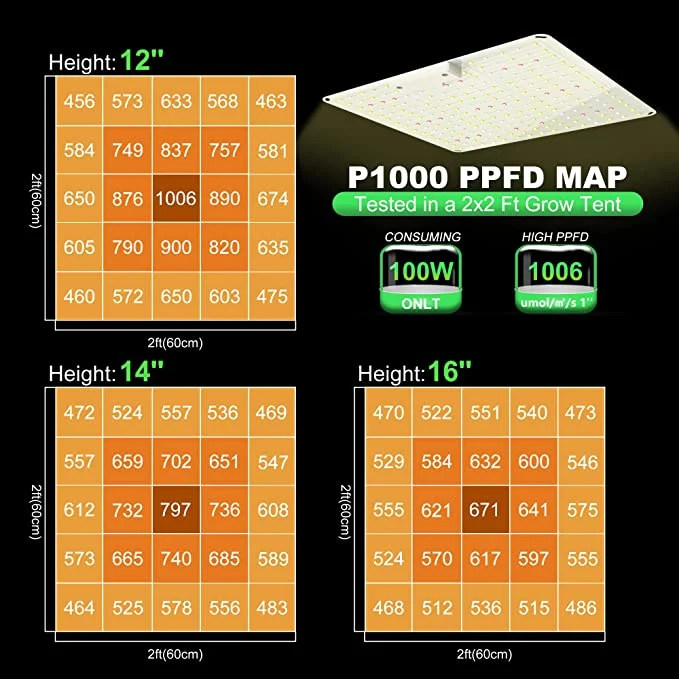
To make a fair comparison of grow lights it is best to know the actual input Watts of the light, the photon output in umol/s, the efficacy in umol/J and a PPFD map for a specific height. PPFD is the measure of the current photons per square cm; Daily Light Integral is a measure of the combined effect of light intensity and duration of light period over a 24-hour day. Use the same area and measurement grid to compare different grow lights. A high reading in the center of a light can hide very low readings in the corners. Be sure to note whether a light is measured for actual draw or if it is a model name with “equivalent” Watts listed, such as the Samsung 75W–480W LED Grow Lights Panel above, that can be compared using this same like-for-like measurement checklist.
Estimate Power from Canopy and Crop Needs
Measure the Real Canopy
Instead of measuring the outside of your grow tent, measure the crop canopy. Your fixture must be able to distribute the light over the entire surface of the crop at the appropriate hanging height and include some dimming headroom for variations in growth stages. Seedlings and dense flowering crops require significantly different intensity plans. A room with multiple growing zones is generally better served by distributing fixtures throughout the room rather than trying to rely on a single very high output light that will not adequately light the crops at the edges of the room.
Use Rules of Thumb Carefully
Treat watt-per-square-foot rules as rough screening tools, not a final design. They cannot account for fixture efficacy, light distribution, crop response, mounting height, or reflective surfaces. Use the manufacturer’s verified map, then measure a grid at the actual canopy level. If the center is too bright while edges are dim, a different fixture layout or wider distribution may solve the problem better than simply raising wattage. Samsung 100W LED Grow Light Quantum Plate can then be compared with the mapped canopy area and target PPFD.
Account for Heat, Dimming, and Electrical Limits
Plan for Heat and Circuit Load
Higher input power normally results in higher photon output and space heat. Consider the location of the driver, the capacity of the surrounding circuits, space cooling, and the energy that will be required by exhaust or air-conditioning units. A dimmable unit can be run below its full output but verify the lowest stable output level as well as any channel control capabilities. Plans for the electrical connections should follow the unit’s nameplate data and local building code. It is best to have a qualified electrician make any changes to the surrounding circuits.
Estimate Whole-Room Energy
Just buying a light by price is not a complete comparison. You must know how many hours a light will be operated for and what that will cost in utilities. Measured input watts times hours of use times the local price per kWh gives one estimated energy consumption for a fixture. Keep separate the energy used for cooling and for ventilation since the efficiency of a light is not the same as the energy demand of a whole room full of plants. The wattage rating of a light is not proof of any harvest, any dollar savings, or any specific life time for any particular light. When buying a high-power light, such as the 800W LM281B LED Grow Light 5x5FT, use measured input and your canopy data to compare lights to what the model name claims.
Compare TIDESTAR Wattage Options Carefully
Review the Available Power Classes
TIDESTAR offers a family of Samsung LED Grow Lights Panels that are dimmable and include 75W, 150W, 240W, 320W, and 480W models. The 240W version has PPF efficacy of 2.734 micromoles per joule, a distribution of 120 degrees and specific diode mix listed for that panel model. Note that the specifications for the other wattage models would need to be verified with the manufacturer, as they are likely to have changed.
Keep Product Figures Specific
Samsung 100W quantum plate is an example of coverage for a smaller growing area: 2.5 x 2.5 feet at 18 inches for vegetative growth and 2 x 2 feet at 14 inches for flowering growth. The higher power models from TIDESTAR are 800W and 1000W high-power LED grow lights, framed for 5 x 5 feet growing areas. Our selection of electrical power classes will cover most growing areas, but the specific choice will depend on several factors including measured canopy coverage, growing area height, temperature, and required control range.
Product facts relevant to this comparison
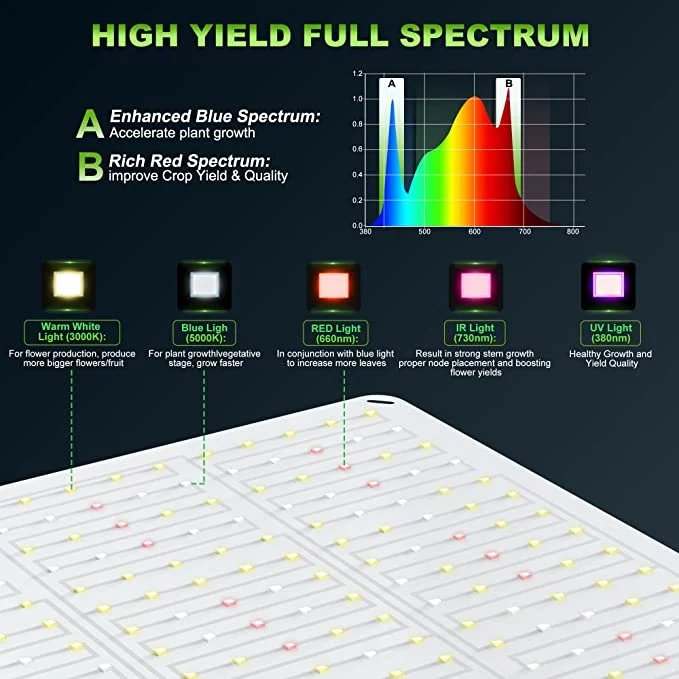
The Samsung LED Grow Lights Panel family is offered in 75W, 150W, 240W, 320W and 480W versions. For the 240W version, this panel features 2.734 micromoles/joule PPF efficacy, 120° light distribution, a built-in dimmer, and a unique 3000K/5000K/660nm red/460nm blue diode mix. Note that the features listed above are for the 240W version only.
The Samsung 100W LED Grow Light Quantum Plate for Veg Bloom is a dimmable Grow Light designed for use with indoor plants. The example area coverage for the Quantum Plate for Veg Bloom for vegetative growth is 2.5′ x 2.5′ at 18″, and for flowering growth is 2′ x 2′ at 14″. Please verify the coverage for the current model and adjust for the specific plants growing in the area to best utilize this example in your design.
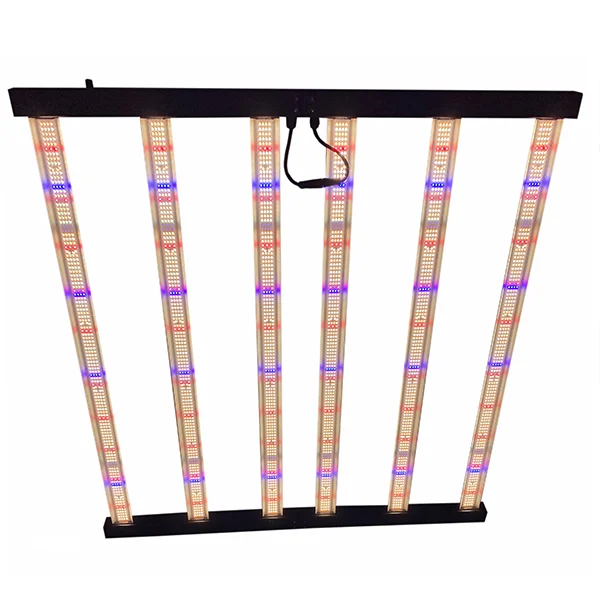
TIDESTAR’s 800W LM281B LED Grow Light is a Dimmable Grow Light specifically designed for horticulture. The description includes Full-Spectrum, UV/IR & 5′ x 5′ Growing Area but does not guarantee a PPFD map, yield, energy efficiency, heat load, or lifetime. All must be verified by measurement and current specification.
TIDESTAR offers a full-spectrum LED grow light made with Samsung LM301B 1000W LED chips, framed for a 5-by-5-foot growing area. We list the nominal power, LED chip type, LED spectrum, and growing area for reference only. Measured canopy light uniformity, potential crop yield, universal applicability, and required cooling all vary from model to model.
Validate the Choice with a Repeatable Test
Map Light Across the Canopy
Record the canopy dimensions and the crop stage, as well as the available height, circuit limitations, and room ambient temperature prior to installation. Start at a conservative dimmer setting and measure at the center and edges of the grow space prior to increasing the height of the lights or rearranging the growing space. Use the same grow space meter, same grid points, same sensor orientation, and same grow space conditions when comparing two grow lights.
Repeat the Trial
Track plant response over days, documenting leaf angle, spacing, color, and canopy temperature as well as light readings. The center of the pot turning white while the edges are stretching indicates that light is not being distributed evenly, and it may not be a matter of adding more wattage. Make one change at a time and keep a running log of the same measurements to create a useful comparison, rather than just reading off the name of the new fixture and taking one reading at one spot.
FAQ
Q: How many watts should an LED grow light use?
A: When selecting a light source, choose by measuring the canopy, the space available to hang lights, the stage of crop growth, and the light needed. Don’t rely solely on a watt/area ratio; a PPFD map is a better representation of grow space, and a check of actual watts input will give you a better sense of a light than a brochure.
Q: Does higher LED grow light wattage mean more plant light?
A: No. More input power does not necessarily mean higher efficacy or better optics, diode design, coverage, or canopy distance. All of these factors affect the amount of light that actually reaches the canopy and how evenly it is distributed.
Q: How do I compare wattage across grow light fixtures?
A: Compare actual input watts, photon output, efficacy and the PPFD maps for a given growing area and for mounting height to the advertised watts as indicated for the model on offer. Is the advertised wattage the actual draw or merely a model description label?
Q: Can dimming replace choosing the right fixture size?
Dimming helps control the output but does not compensate for fixtures that do not illuminate the canopy edges or do not provide adequate coverage. Design the grow area first and then use dimming for scene control and to increase or decrease intensity.
Q: How can I test whether canopy coverage is adequate?
A: Measure a repeatable grid at canopy height, including center and corners, with the same meter position and dimmer setting. Record crop response and temperature, then change one variable before repeating the map.