

How Should Buyers Plan Grow Lights for Greenhouse and Vertical Farm Projects?
Buyers should begin with the crop, planted canopy, light deficit, facility geometry, and operating schedule. A greenhouse normally receives sunlight, while a vertical farm depends mainly or entirely on electric lighting. That difference changes fixture output, layout, controls, heat management, and operating hours. Wattage or a quoted coverage area alone cannot determine how many grow lights for greenhouse or vertical production are required.
Why Are Grow Lights for Greenhouse Projects Usually Supplemental?
Greenhouse lighting usually fills a seasonal or cloudy-day deficit. Start with the sunlight that actually reaches the canopy after glazing transmission, structural shading, screens, latitude, and season are considered. The electrical system then supplies the missing daily light rather than treating the greenhouse like a sealed grow room. This is why a fixed watts-per-square-meter rule is unreliable.
Why Does Vertical Farm Lighting Require a Different Plan?
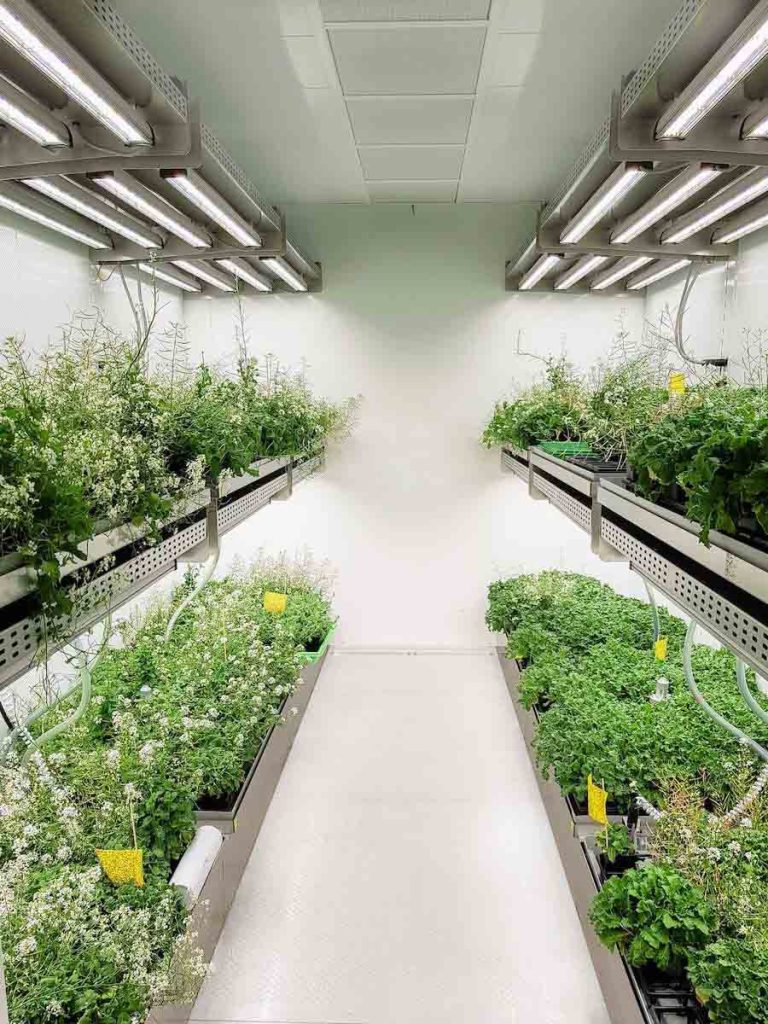
In vertical farm lighting, every rack tier needs controlled PPFD, uniformity, clearance, wiring, and heat removal. Short mounting distances make fixture profile and edge output important. A thick fixture or poorly placed driver can reduce tier clearance, while uneven spacing can create repeatable dark zones on every tray.
How Do You Calculate Light Demand Before Buying Grow Lights for Greenhouse Use?
Start With Crop DLI and the Natural Light Deficit
Set a crop- and stage-specific target DLI, then estimate the natural DLI reaching the planted canopy. The difference is the supplemental lighting requirement. TIDESTAR’s LED grow light category and DLI calculator combines PPFD and illuminated hours to calculate daily light integral, or calculates PPFD or photoperiod when the other two values are supplied. It is useful planning support, but site measurements still define the project.
Convert the Light Target Into PPFD, Photoperiod, and Coverage
Convert the remaining daily target into a required supplemental PPFD and practical operating window. Calculate from the planted canopy, not the building floor area. PPFD describes plant-usable light reaching leaves and similar surfaces, and it changes with distance. Compare average, minimum, and edge readings across the footprint; a strong center reading or high fixture PPF does not prove useful grow light coverage.
Which LED Grow Light Layout Fits Greenhouses and Vertical Farms?
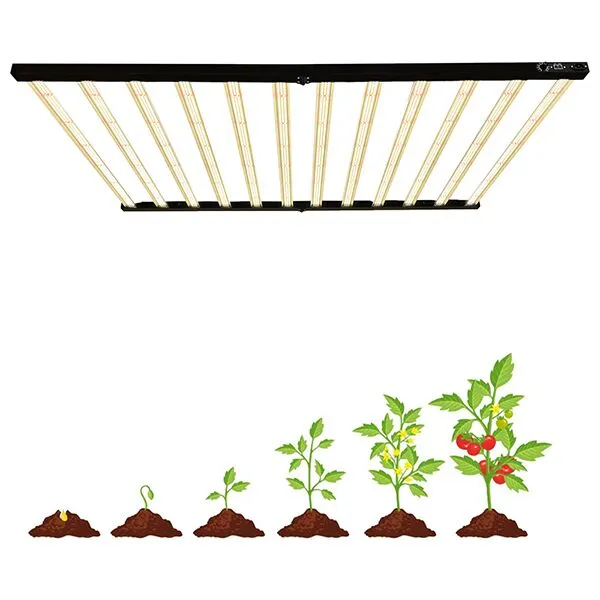
Greenhouse Top Lighting and Supplemental Coverage
Greenhouse top lighting can cover broad crop rows while preserving sunlight access. Align fixture spacing with bays, trusses, crop rows, and service routes. Avoid unnecessary obstruction from fixtures, drivers, and structural members. Tall crops may need a distribution strategy that reaches more than the top leaves, but the goal remains supplemental coverage rather than recreating a fully enclosed room.
Vertical Farm Rack Lighting and Close-Canopy Coverage
Vertical farm rack lighting favors slim fixtures matched to tray width and rack depth. Check the distance from LEDs to the mature canopy, not only to an empty tray. Driver position, irrigation clearance, cable routing, and edge-to-edge PPFD uniformity affect both crop capacity and maintenance. A few centimeters of fixture height can matter when multiplied across many tiers.
When Are Multiple Smaller Fixtures Better Than One High-Power Fixture?
Multiple LED grow lights can be better for irregular greenhouse bays, rack modules, propagation zones, or crops needing independent dimming. Overlapping footprints may smooth bright and weak areas and make zoning easier. One high-power fixture can simplify installation over a wide regular canopy, but high wattage is not the definition of commercial quality.
What Specifications Matter When Buying Commercial LED Grow Lights?
Compare PPF, PPE, PPFD Maps, and Uniformity Together
Request PPF, PPE in micromoles per joule, actual input power, a tested PPFD map, test height, footprint, average PPFD, and minimum or edge readings. Read these specifications as one package. PPF describes total photon output, PPE relates output to electrical input, and the PPFD map shows where that light reaches the test plane. Wattage does not equal usable canopy light.
Check Moisture Protection, Thermal Design, Dimming, and Controls
For greenhouse grow lights, assess humidity, condensation, irrigation exposure, dust, and operating temperature. For close-canopy racks, assess heat accumulation between tiers, driver location, cable routing, and centralized controls. Dimming supports crop zones and seasonal adjustment.
TIDESTAR manufactures and sells indoor plant-growing products, including LED grow lights and hydroponic systems, for hobbyists and commercial growers. Our product planning covers design, manufacturing, and after-sales support, but buyers should still verify each fixture against the project’s environmental and electrical conditions.
How Should Facility Infrastructure Affect Grow Light Selection?
Plan Electrical Capacity, HVAC, and Environmental Controls
Multiply fixture quantity by actual input watts, then check available voltage, circuits, control zones, and startup loads. Add lighting power to the facility heat balance. LEDs do not eliminate heat; they change how heat is distributed and how much is radiant toward the crop. Greenhouses must balance solar gain and ventilation, while vertical farms may need greater cooling and dehumidification.
Plan Mounting, Service Access, and Future Expansion
Confirm mounting points, hanging clearance, aisles, cleaning access, driver replacement, crop-height changes, and future bay or rack expansion. Ask for a light plan before approving the quotation. Solving fixture spacing on paper is less disruptive than moving power, irrigation, or racks after delivery.
TIDESTAR Grow Lights for Greenhouse and Vertical Farm Planning
High-Output LED Grow Lights for Wider Commercial Canopies
The 1000W 1200W 1400W 4x6FT LED Grow Lights Samsung lm301B Full Spectrum Lamp uses a 12-bar layout and is presented for a 4 x 6 ft footprint. Current product information identifies dimming, passive thermal management, and IP65 dust-and-humidity resistance. It is a practical wide-canopy example, provided its PPFD map and mounting plan match the project.
Medium-Power LED Grow Lights for Propagation and Vertical Production
The Samsung 240W 320W 480W LED Grow Lights Full Spectrum range is dimmable and is presented for mother plants, rooting of cuttings, and vegetative growth. It illustrates how different outputs can serve propagation and production zones without forcing one fixture size across the whole facility.
Compact LED Panels for Multi-Tier and Early-Growth Areas
The 35W 65W Full Spectrum LED Quantum Grow Light Panel uses LM281B Samsung diodes, dimmer control, and passive fanless cooling. Its source entry includes an adjustable rope, power cord, and hanging kit. Compact panels can suit seedlings, experimental zones, and small rack modules when measured output and mounting distance fit the crop.
The planning rule is consistent across all three examples: match fixture form, output, controls, and environmental protection to measured crop and facility requirements.
FAQ
Q: How many grow lights for greenhouse production are needed per square meter?
A: No single dependable number exists for every situation. Growers must calculate the amount from several important factors. These factors include crop DLI. They also cover sunlight that reaches the canopy. Fixture PPFD distribution plays a key role too. Mounting height matters. Planted area and operating hours remain essential as well.
Q: How should grow lights for greenhouse crops be sized using PPFD and DLI?
A: First estimate the natural DLI at canopy level. Then subtract this value from the crop target. Next, convert the remaining requirement into supplemental PPFD. Also determine the proper photoperiod. Finally, verify the installed layout. Use direct canopy measurements for this step.
Q: Are LED grow lights for greenhouse production different from vertical farm lights?
A: The same fixture family may serve both uses. Yet the lighting plan differs between them. Greenhouses usually supplement sunlight. Vertical farms need close-canopy lighting. This lighting must fit racks. It supplies most or all crop light in those setups.
Q: How high should grow lights for greenhouse crops hang above the canopy?
A: Start with the manufacturer’s tested height. This provides a useful beginning point. Then check PPFD levels carefully. Examine uniformity across the area. Consider crop height at the same time. Review heat output too. Also look at any obstruction of sunlight. Make final adjustments from actual measurements. Avoid depending on one fixed distance.
Q: What specifications should buyers compare when choosing grow lights for greenhouse projects?
A: Buyers should compare PPF and PPE values. Input power requires close attention as well. Reviewed, tested PPFD maps offer important details. Note the test height used in those maps. Check average readings and edge readings. Dimming features matter. Control options deserve review. Moisture protection remains critical. Thermal design affects long-term performance. Voltage compatibility needs confirmation. Service access influences maintenance ease.


