
A quantum panel grow light differs from a traditional LED grow light mainly in light distribution. It spreads many diodes across a flat board, creating a broad source that can deliver more even canopy coverage. Traditional LEDs may use smaller boards, bars, or concentrated emitter groups. Neither format is automatically better: choose by target PPFD, canopy size, mounting height, efficiency, heat management, and budget.
What Is a Quantum Panel Grow Light and How Does It Work?
Understanding the Design Behind Quantum Panel LED Technology
A quantum panel grow light is a flat LED fixture with multiple diodes arranged across a relatively large emitting surface. Distributing the diodes across the board helps illuminate more of the canopy from one mounting position. However, diode spacing, board size, optics, driver design, dimming, spectrum, and mounting height still determine real performance.
TIDESTAR’s full-spectrum quantum panel family is listed in 75W, 150W, 240W, 320W, and 480W versions. This range identifies product options rather than prescribing a power level. For smaller installations, the 35W/65W full-spectrum LED quantum grow light panel illustrates a compact panel with dimming and passive fanless cooling.
We use the family range only to identify available form factors. The final choice must match measured coverage, crop needs, height, and operating conditions.
Why Quantum Panel Grow Lights Became Popular for Indoor Growing
A broad panel can make coverage easier to manage in tents, racks, and propagation areas. Its distributed source may reduce center hotspots and edge falloff across a regular canopy. Some panels also use passive cooling, removing fan noise and maintenance. These are design advantages, not guarantees: room airflow, driver placement, fixture loading, and hanging distance remain important.
How Does a Quantum Panel Grow Light Compare With Traditional LED Grow Lights?
Differences in Light Distribution and Coverage
Quantum panels generally spread emission across a larger surface. Compact traditional fixtures can concentrate intensity near the center, although a well-designed bar light can also distribute light effectively. The practical test is a PPFD map measured at a relevant height, not the fixture label.
PPFD describes plant-usable light reaching the leaves, so check readings at several points rather than judging brightness from the center alone. Plants that receive too little light may stretch or develop long internodes; excessive intensity can contribute to scorch or bleaching. Reflective walls, canopy shape, hanging height, and diode layout all affect uniformity.
Differences in Efficiency and Power Usage
Compare useful photon output with electrical input. PPE or efficacy is helpful, but it should be read with the PPFD map, test height, coverage target, and dimmer setting. Wattage alone does not reveal how much usable light reaches edge plants.
Both formats can be efficient. A panel may cover a regular area without overdriving the center, while a bar or compact fixture may better fit a long, divided, or small canopy. Base the energy decision on measured whole-canopy performance rather than a universal savings claim.
For a useful comparison, record average and minimum PPFD, wall-plug power, mounting height, and dimmer setting under the same test conditions. This prevents an impressive center reading from hiding weak edge coverage.
Does a Quantum Panel Grow Light Provide Better Plant Growth Results?
How Light Uniformity Supports Healthier Plant Canopies
A quantum panel can support more consistent canopy development when its PPFD distribution matches the plant area. Even exposure can reduce deep shadow zones and the difference between center and edge plants. It does not guarantee higher yield: species, growth stage, photoperiod, nutrition, irrigation, airflow, and plant response still determine results. Measure when possible and adjust height or dimming as plants grow.
How Full Spectrum Output Supports Different Growth Stages
Full-spectrum output can support a full-cycle setup from vegetative growth through flowering when intensity and photoperiod are appropriate for the crop. Spectrum alone does not determine performance.
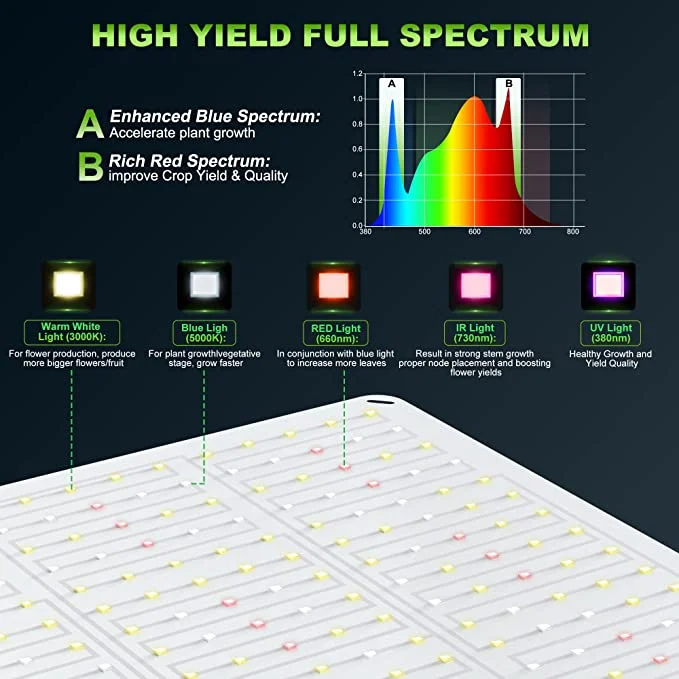
For example, TIDESTAR’s specified 240W quantum panel entry combines 3000K, 5000K, 660nm red, and 460nm blue diodes, with a dimmer knob, a stated 120° light distribution, and PPE of 2.734 μmol/J. These specifications apply only to that listed entry. They must not be generalized to every quantum panel.
What Features Should You Look for in a Quantum Panel Grow Light?
Check Efficiency, PPFD Distribution, and Coverage Area
Use four checks before buying:
- PPFD map:Review center and edge readings across the intended canopy.
- Test conditions:Confirm height, dimmer setting, and vegetative or flowering use.
- Efficiency:Compare PPE with usable coverage, not as a standalone number.
- Control:Prefer dimming when one fixture must serve different growth stages.
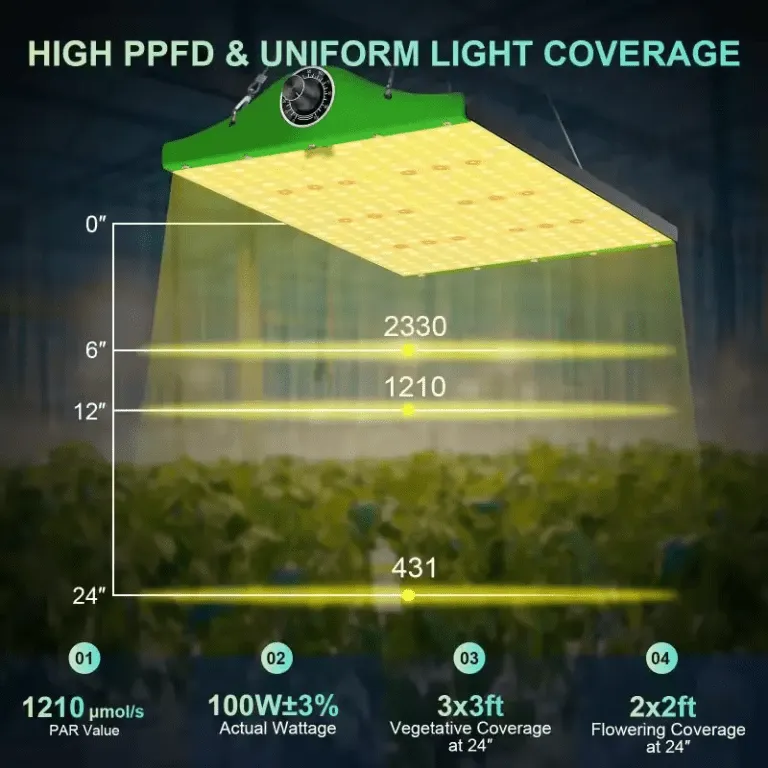
Coverage area is a planning estimate, not a guarantee. A 100W quantum plate, for instance, has source-specific example coverage of 2.5 ft × 2.5 ft for vegetative use at 18 inches and 2 ft × 2 ft for flowering use at 14 inches. Treat these as model-specific examples because crop and target PPFD can change practical coverage.
Consider Heat Management and Installation Flexibility
A panel with passive cooling can reduce fan noise and simplify maintenance, but it still needs ventilation around the heat sink and driver. Check clearance, driver placement, power-cord length, dimmer access, weight, and mounting hardware. Some 35W/65W panel kits include an adjustable rope, power cord, and hanging kit; do not assume every panel includes the same accessories.
Is a Quantum Panel Grow Light Better Than Traditional LED for Your Setup?
When Quantum Panel Grow Lights Are a Better Choice
Choose a quantum panel when a regular canopy needs broad coverage, dimming, or quiet passive cooling. These priorities suit grow tents, propagation shelves, and commercial rooms with repeatable plant spacing.
TIDESTAR’s Samsung LED quantum panel family provides several listed sizes. Shortlist by form factor, then verify the selected model’s PPFD map, dimensions, driver arrangement, and installation requirements.
When Traditional LED Grow Lights May Still Work Well
Traditional LEDs can remain practical for a small setup, low-light crop, single shelf, unusual layout, or limited initial budget. Bar fixtures can suit long benches or row lighting. If an existing fixture already reaches the target PPFD without serious hotspots or edge loss, changing formats may offer little practical value.
How to Choose the Right Quantum Panel Grow Light for Indoor Growing?
Match Light Coverage With Your Growing Area
Measure the canopy rather than only the tent walls. Record plant-area length and width, maximum plant height, reflective surfaces, and available hanging range. Compare that area with a PPFD map tested at a similar height. Recheck after plants grow upward because a shorter distance can raise intensity while narrowing uniform coverage.
Select the Right Power Level for Plant Requirements
Start with target PPFD, canopy area, growth stage, and operating schedule. Select a model that reaches those conditions with useful dimming headroom. This is more reliable than choosing the highest wattage. Also confirm circuit load, room ventilation, heat load, and hanging hardware before purchase.
For a compact reference point, compare the Samsung 100W quantum plate for veg and bloom with your measured canopy, target PPFD, and available mounting height.
FAQ
Q: What is a quantum panel grow light?
A: It is a flat LED fixture with many diodes distributed across a broad board. The larger emitting surface can support even canopy coverage when layout, height, and output match the growing area.
Q: Is a quantum panel grow light better than a traditional LED grow light?
A: It can be better for a regular canopy where uniformity, dimming, and passive cooling matter. Traditional LED may suit smaller areas, unusual layouts, lower light needs, or tighter budgets.
Q: How does a quantum panel grow light improve light distribution?
A: Spreading diodes across a larger surface sends light from more positions. Actual uniformity still depends on spacing, mounting height, reflective surfaces, and the PPFD map; a panel does not automatically eliminate hotspots.
Q: What size quantum panel grow light do I need for indoor growing?
A: Choose a size that delivers the crop’s target PPFD across the measured canopy at a workable height. Check the PPFD map, growth stage, dimmer setting, and plant response instead of relying on one coverage number.
Q: Are quantum panel grow lights good for full-cycle plant growth?
A: Yes. A suitable full-spectrum panel can support vegetative and flowering stages when intensity, distance, photoperiod, and plant response are managed correctly.