

A high average PPFD can hide weak corners, bright center zones, or stripes between light bars. The more useful question is whether photons reach the productive canopy consistently. LED bar count and spacing shape that result, but neither variable works alone. A reliable comparison also considers fixture dimensions, mounting height, optical spread, and the test footprint.
What PPFD Uniformity Really Measures in a Multi-Bar Fixture
PPFD describes the photosynthetically active photons reaching a square meter each second. Uniformity describes how evenly readings are distributed across the measured area. A multi-bar fixture can produce a strong average while delivering very different levels to plants in the center, along the perimeter, and at the corners.
Why Average PPFD Cannot Describe the Whole Canopy
An average compresses every grid reading into one number. A powerful center can disguise weak edges or dark lanes. Two fixtures with the same average PPFD may therefore support different usable canopy areas. Persistent low zones can slow growth, while concentrated peaks may force a higher mounting position or lower dimmer setting.
How Minimum, Average, and Maximum Readings Reveal Uniformity
Read the minimum, average, and maximum together. The minimum-to-average ratio describes the weakest point relative to overall output, while the maximum-to-average ratio shows how sharply a zone rises above the field. These ratios are meaningful only when the footprint and grid are identical. Inspect the map visually because one minimum cannot show whether the weakness is a corner or a long band between bars.
How LED Bar Count Changes Photon Distribution
Dividing the Same Output Across More Light Sources
When comparable total output is distributed across more bars, each source line contributes a smaller share. With suitable spacing, adjacent beams overlap before pronounced gaps form, illuminating a wide canopy without one intense central source. Bar count is a distribution tool, not a stand-alone measure of quality.
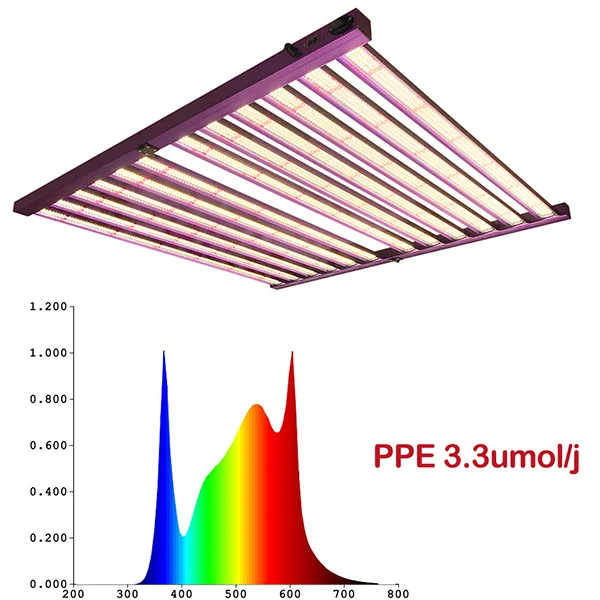
At TIDESTAR, our 1000w Full Spectrum 5x5ft Samsung lm301H Foldable Plant LED Grow lights uses 12 bars and 4,032 diodes, with 336 diodes on each bar. Its specified efficacy is 3.34 micromoles per joule. The 116 by 110 by 4 centimeter frame uses passive thermal management and is specified for a 150 by 150 centimeter growing space. Its 3,000K and 5,000K Samsung LM301H white diodes are paired with 660 nm Osram red diodes, and the fixture accepts 120-240V input with a recommended mounting height of at least 15 centimeters.
Why More LED Bars Do Not Automatically Guarantee Better Uniformity
Adding bars without redesigning the frame may crowd more emitters into the center. Uniformity can also suffer when outer bars sit too far inside the boundary or diode density varies by bar. Compare bar count, center-to-center spacing, outer-bar position, frame width, and power distribution. More bars help only when they create useful overlap across the intended footprint.
How Bar Spacing Controls Overlap and Edge Coverage
Wide Spacing and the Risk of Dark Bands Between Bars
Wide spacing stretches the fixture and can move light closer to the canopy perimeter. The tradeoff is weaker overlap, especially at a low hanging height. On a PPFD map, insufficient overlap often appears as parallel valleys following the frame gaps. If those valleys remain inside the productive canopy, nominal coverage exceeds consistent coverage.
Evaluate spacing at crop level, not from the frame alone. The gap projected onto the canopy depends on beam spread and distance, so equal mechanical spacing does not guarantee equal photon distribution.
Narrow Spacing, Center Hotspots, and Wasted Perimeter Light
Narrow spacing increases overlap near the fixture center. That can smooth the areas between bars, but excessive overlap may produce a central plateau while leaving the edges relatively weak. If the whole fixture must be dimmed or raised to control the center, some installed capacity is not being used where it is most valuable.
Outer-bar placement deserves separate attention. Moving the outer sources slightly closer to the footprint boundary can strengthen edge coverage, yet pushing them too far outward sends more photons beyond the growing area. The best layout balances inner overlap with perimeter compensation instead of applying one identical gap without checking the resulting map.
Why Bar Count, Spacing, and Mounting Height Must Be Evaluated Together
How Hanging Height Changes the Overlap Between Adjacent Bars
Increasing mounting height gives light from neighboring bars more distance to blend. Dark lanes usually soften and the footprint broadens, while peak PPFD falls. Lowering the fixture tends to increase intensity but exposes differences between source lines more clearly. This interaction explains why a spacing pattern that works at one height may perform poorly at another.
For a lower bar-count reference, our Samsung LM281b LED Grow Lights 720w Grow Light Full Spectrum uses six bars and 2,016 diodes, again with 336 diodes per bar. Its specified efficacy is 2.6 micromoles per joule, and the product information recommends at least 15 centimeters between the fixture and plants. The 109 by 105 by 4 centimeter frame has a built-in driver, passive thermal management, and 25-percent dimming steps. It combines 3,000K and 5,000K Samsung LM281B white diodes with 660 nm red diodes and accepts 110-277V input.
How Beam Angle and Fixture Dimensions Shift the Best Spacing
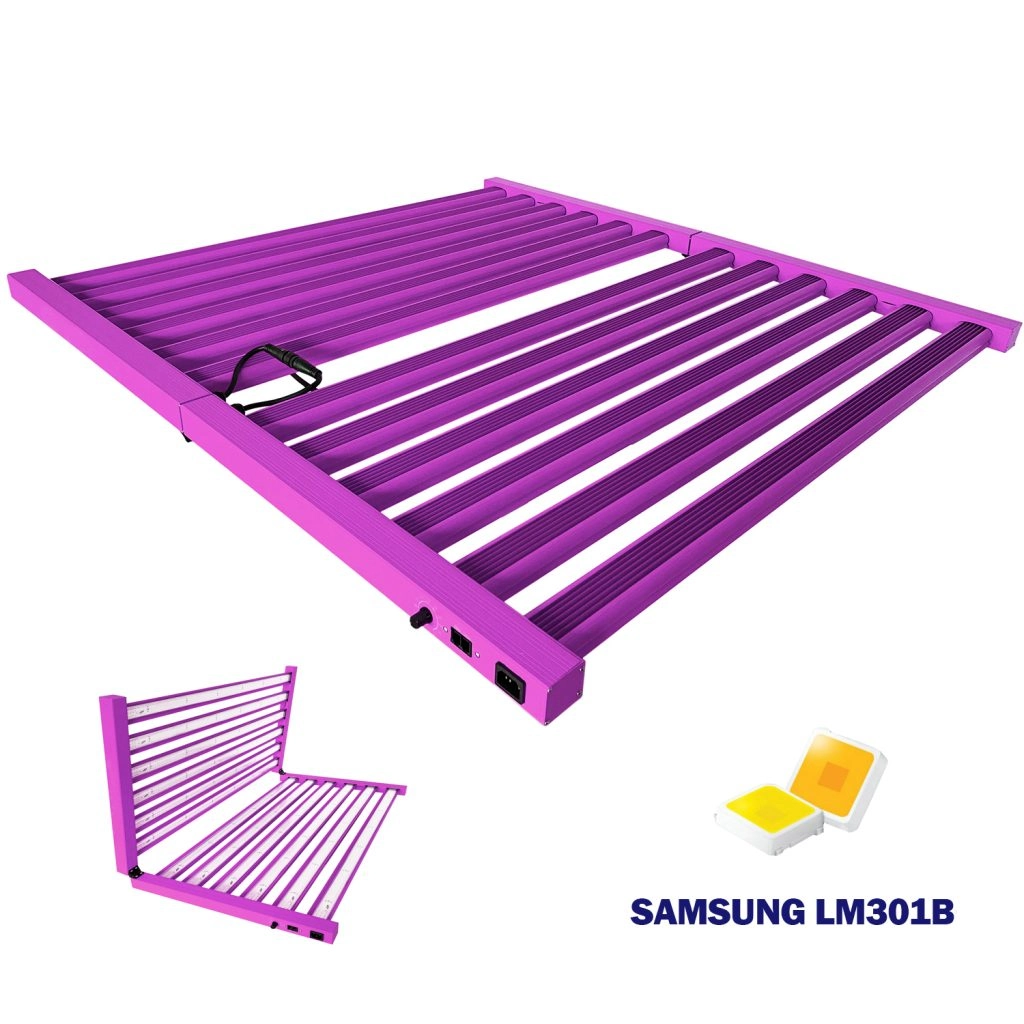
Bar spacing cannot be optimized independently of optical spread. A wider emission pattern promotes overlap at a shorter distance but may increase spill outside the canopy. A narrower pattern can preserve intensity farther from the source, yet it may require greater height or closer bar spacing to erase gaps. The TIDESTAR 800w UV IR Samsung lm301B LED Grow Light Full Spectrum 2 Channels Dimming uses independent controls for white and red output and for UV light. Such channel control changes how a fixture can be tuned, but it does not replace a PPFD map.
How to Compare Multi-Bar Fixtures Using a PPFD Map
Check the Test Height, Footprint, Grid, and Environment
Start by confirming four conditions: mounting height, measured footprint, grid density, and test environment. A map recorded over a smaller area can look more uniform because weak perimeter points were excluded. A coarse grid can miss narrow valleys between bars. Reflective tent walls may also raise edge readings compared with an open-room test. Comparisons are credible only when these conditions are disclosed and reasonably matched.
Read the Center, Gaps, Edges, and Corners as Separate Zones
Do not scan only for the highest and lowest numbers. Trace the centerline, then inspect the spaces directly below and between bars. Next, examine all four edges and corners. This zone-by-zone method shows whether a problem comes from excessive central overlap, insufficient overlap between bars, or poor perimeter reach. It also reveals whether one isolated reading or a repeated geometric pattern is driving the uniformity ratio.
Match the Bar Layout to the Productive Canopy
The best fixture is not the one with the most bars; it is the one whose verified map fits the area that will actually hold plants. Define the productive canopy first, set a realistic hanging-height range, and compare maps at useful dimming levels. TIDESTAR’s LED grow light bar range includes layouts with different frame sizes and bar counts, which allows buyers to evaluate distribution architecture alongside total output. The final decision should prioritize usable, repeatable coverage rather than a single peak value.
FAQ
Q: How many LED bars are needed for good PPFD uniformity?
A: There is no universal bar count. The suitable number depends on canopy dimensions, total photon output, bar length, optical spread, mounting height, and edge placement. Compare PPFD maps produced over the same footprint and at the same height instead of using bar count alone.
Q: Does closer LED bar spacing always improve PPFD uniformity?
A: No. Closer spacing can reduce valleys between adjacent bars, but it may also concentrate too much light near the center and weaken relative edge coverage. The spacing should be tested as part of the complete fixture geometry.
Q: How does hanging height affect PPFD uniformity between bars?
A: A greater hanging height usually increases beam overlap and smooths differences between bars, although it also lowers peak intensity and can increase spill. A lower height raises intensity but can make bright lines and dark gaps more visible.
Q: What PPFD map readings indicate uniform LED grow light coverage?
A: Review the minimum, average, and maximum values, calculate their relationships, and inspect the spatial pattern. Strong coverage shows controlled center peaks, limited valleys between bars, and acceptable readings at the edges and corners of the productive canopy.
Q: Can dimming fix poor PPFD uniformity caused by bar spacing?
A: Dimming can reduce excessive intensity, but it normally changes output across the whole fixture rather than correcting the geometric pattern. If spacing creates persistent dark lanes or weak edges, mounting height or fixture layout usually needs to change as well.


