
The contrast between 720 watts and 800 watts can seem straightforward on a specification sheet. Yet wattage only shows the electrical input. It does not show how many helpful photons a fixture creates. It also does not indicate how well those photons spread to the canopy. In addition, it fails to tell whether the room can handle the extra heat.
A good comparison begins with the planned canopy and the actual operating conditions. The better choice is the fixture that achieves the desired light level. It does so with suitable uniformity. It also matches the electrical needs and leaves margin for climate control.
Start With the Real Decision: More Intensity or More Operating Headroom?
Why Rated Watts Alone Cannot Predict Usable Light
Two fixtures with different wattages can create similar PPF. This happens when their photon efficacies are not the same. PPF measures total photosynthetic photon output in micromoles per second. Efficacy measures output per joule of electrical energy. Fixture size, diode spacing, optics, and hanging height then decide how much of that PPF actually reaches the planted area.
This is why buyers should review the full set of specifications. They should not focus only on the wattage printed on a carton. TIDESTAR’s LED grow light range includes several bar layouts and power levels. This range lets buyers evaluate the electrical rating together with form factor, dimming, spectrum, and intended coverage.
What the Extra 80 Watts Actually Changes
At equal efficacy, 800W LED Grow Lights can produce about 11.1% more PPF than 720W LED Grow Lights. They also draw 11.1% more electricity. They add roughly the same percentage of heat to a closed grow space. That increase may give useful intensity headroom. Yet it is not automatically a larger usable footprint.
The practical question is whether the additional output improves the weakest canopy zones. It could support a higher mounting position. Or it might simply make an already bright center even brighter.
Compare PPF and Efficacy on Equal Terms
Calculate Photon Output Before Comparing Model Labels
Estimate PPF by multiplying system input power by photon efficacy. At a common efficacy of 2.9 micromoles per joule, a 720W fixture would produce about 2,088 micromoles per second. An 800W fixture would produce about 2,320. The 232-micromole difference is useful only if the fixture distributes it across the intended canopy.
At equal 2.9 µmol/J efficacy, the comparison is 2,088 versus 2,320 µmol/s of estimated PPF. Approximate fixture heat load is 2,457 versus 2,730 BTU/h.
An LED grow light 720w specification should therefore disclose measured input power, system-level efficacy, and PPF. The same rule applies to an LED grow light 800w specification. Diode brand or a large wattage number cannot replace those measurements.
Separate Maximum Output From Normal Operating Output
Many growers rarely run a high-power fixture at 100% through every crop stage. A dimmable 800W unit operating at 90% draws about 720W. Yet it may not behave exactly like a purpose-built 720W fixture. Its larger frame or additional bars could improve distribution. At the same time, its driver and diode loading could change efficacy at the dimmed setting.
Ask for PPFD maps at the power levels and hanging heights that you will actually use. Maximum-output data alone cannot predict daily operation.
Compare Heat Load at Fixture and Room Scale
Convert Electrical Power Into a Cooling Estimate
For a closed room, a conservative lighting heat estimate is input watts multiplied by 3.412 BTU per hour. That gives about 2,457 BTU/h for 720W and 2,730 BTU/h for 800W. The difference is roughly 273 BTU/h per fixture.
One light may not change the cooling plan. Across 20 fixtures, however, the 80W difference becomes 1.6 kW of additional electrical load. It also adds about 5,460 BTU/h of extra heat. You should check circuit capacity, cooling redundancy, dehumidification, and local summer conditions at room scale.
Understand What Driver Placement Can and Cannot Do
A remote driver can move part of the sensible heat away from the canopy. If it sits outside the conditioned grow area, it can reduce the cooling load inside that area. If it remains in the same sealed room, total facility heat is essentially unchanged. Even so, canopy temperatures may become easier to manage.
Passive heat sinks and open bar spacing help spread heat. They also support airflow. Still, they do not erase electrical energy. Record fixture input with a power meter. Then verify temperature after the room reaches steady operation.
Compare Canopy Coverage With PPFD Maps
Use Average and Minimum PPFD, Not the Center Peak
Coverage should be defined by a measured grid at a stated height, footprint, power setting, and wall condition. Compare average PPFD, minimum PPFD, and minimum-to-average uniformity. A high center value can hide weak corners. This is especially true when a map is cropped inside the advertised boundary.
Use the same footprint and scale when comparing 720W LED Grow Lights with 800W LED Grow Lights. If one map covers 5 x 5 ft and the other covers 4 x 4 ft, their averages are not directly comparable.
Decide Whether 800W Extends Coverage or Raises Intensity
More PPF can be used in two ways. The fixture may stay at the same height and raise PPFD. Or it may be mounted higher to spread light over a broader area. The second option works only if the outer cells remain within the crop’s acceptable range.
Bar count and physical dimensions matter here. A wide eight-bar frame may distribute photons differently from a compact six-bar frame. This holds even when both draw similar power after dimming. Judge the usable boundary. Do not rely on the nominal wattage class.
Choose Between 720W and 800W LED Grow Lights
When 720W LED Grow Lights Are the Better Fit
A 720W fixture is often the stronger choice when its PPFD map already meets the canopy target. This is true if the room has limited cooling or circuit capacity. It also applies when several fixtures must operate together. Lower input also reduces daily energy use. The 80W gap equals 0.96 kWh over a 12-hour cycle or 1.44 kWh over an 18-hour cycle per fixture.
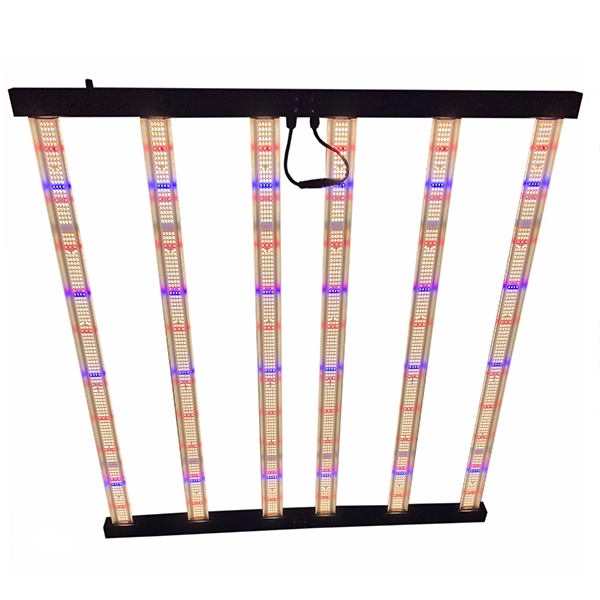
The Samsung LM301B LED Grow Light 720w Built-in LED Driver Grow Lights Full Spectrum is listed with six bars, 2.9 µmol/J efficacy, and 2,088 µmol/s PPF. At TIDESTAR, our recommendation is to verify those output figures against the planned footprint, mounting height, and dimmer position before finalizing a room layout.
When 800W LED Grow Lights Justify the Extra Power
An 800W option makes sense when the canopy needs more total photons. It also fits when the fixture can use the additional output at the edges. Or it works if a higher mounting position is required for clearance and uniformity. It can also provide dimming reserve. The light may run below maximum most of the cycle. At the same time, it retains headroom for later stages.
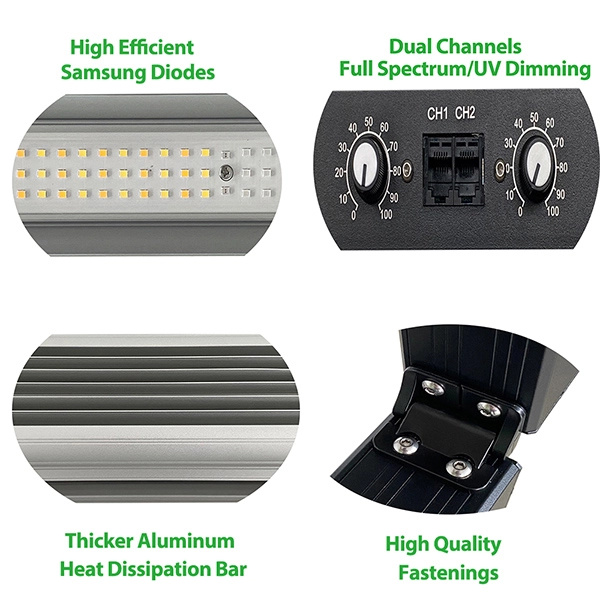
The 800w UV IR Samsung lm301B LED Grow Light Full Spectrum 2 Channels Dimming uses an eight-bar frame and separate control for its main and UV channels. Its page lists 3.18 µmol/J efficacy, passive thermal management, and an unfolded size of 115.3 x 109.3 cm. Confirm measured PPF and a comparable PPFD map rather than inferring coverage from 800W alone.
FAQ
Q: Do 800W LED Grow Lights always cover more area than 720W LED Grow Lights?
A: No. Coverage depends on PPF, fixture dimensions, bar spacing, optics, hanging height, and the PPFD threshold used to define the usable canopy. Compare maps over the same footprint and conditions.
Q: How much more heat does an 800W LED grow light produce than a 720W model?
A: At full measured input, the 80W difference represents about 273 BTU/h in a closed room. Multiply that difference by the number of fixtures when estimating room-level cooling.
Q: Can an 800W LED grow light be dimmed to operate like a 720W fixture?
A: It can be dimmed to approximately the same electrical draw. However, its distribution may differ because of frame size, bar count, driver behavior, and diode loading. Check a PPFD map at the dimmed setting.
Q: Which PPF value is good for 720W LED Grow Lights?
A: There is no universal number. Divide measured PPF by actual input watts to obtain system efficacy. Then determine whether the resulting PPFD map meets the crop’s target across the whole canopy.
Q: Should growers choose 720W or 800W LED Grow Lights for a 5 x 5 ft canopy?
A: Choose the fixture whose verified map delivers acceptable average and minimum PPFD at a workable height. Then confirm electrical capacity, heat removal, dimming range, and operating cost before purchase