

Why Fixture Shape Matters More Than a Single Center PPFD Number
Two fixtures can draw similar power yet produce very different light patterns. The reason is physical: diode spacing, fixture width, and hanging height determine where photons overlap before they reach the canopy. A strong center reading may look impressive, but it says little about corner intensity, edge growth, or how much of the stated footprint remains productive.
A useful comparison, therefore, starts with the entire PPFD map. Look at the average, the lowest readings, and the distance between the center and the edges. At TIDESTAR, we offer both bar and panel formats because neither shape is automatically right for every room. The better choice is the one whose illuminated footprint matches the crop layout at a practical height.
How a Grow Light Bar Distributes Light Across the Canopy
Spaced Diodes Create Multiple Light Paths
Edge and Corner Illumination
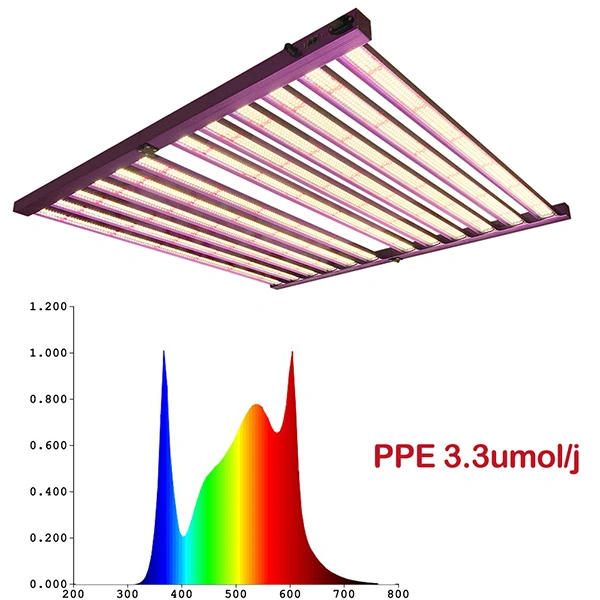
A grow light bar fixture spreads its diodes across several rails instead of concentrating them on one central board. Outer bars place light sources closer to the perimeter, while inner bars overlap across the middle. On a broad, level canopy, that geometry can reduce the difference between center and edge readings.
Cross-Lighting Across a Dense Canopy
Light from neighboring bars reaches leaves from slightly different angles. This can reduce small shadows around overlapping leaves, especially when the fixture nearly matches the canopy width. It does not guarantee deep penetration, however. Plant spacing, pruning, intensity, and canopy density still determine how much light reaches lower foliage.
Open-Frame Geometry Changes Heat and Hanging Strategy
Heat Spread Across a Wider Fixture
An open frame distributes heat-producing components over a larger area. That may reduce concentrated hot zones above the canopy, although a 700-watt fixture still adds roughly the same electrical heat to the room as another 700-watt fixture. Ventilation planning must therefore follow actual input power, not fixture shape alone.
Coverage at Lower Hanging Heights
A broad fixture can maintain useful edge coverage at a relatively low mounting position because its emitters already span much of the growing area. For example, our 1000W 1200W 1400W 4x6FT LED Grow Lights Samsung lm301B Full Spectrum Lamp uses 12 bars across a frame specified for a 4-by-6-foot area. The correct height still depends on the measured PPFD map and crop target.
How a Quantum Panel Shapes Light in a Compact Footprint
Dense Board Layout Creates a Different PPFD Map
Strong Output Beneath the Fixture Center
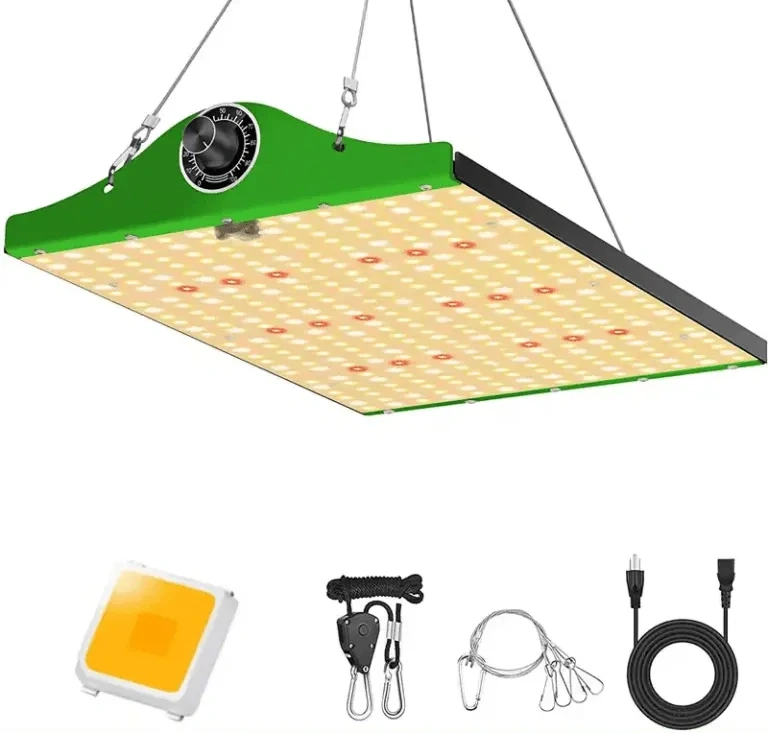
A quantum panel places many diodes on a compact board. With one panel centered over a small growing zone, much of the output overlaps below the fixture. That arrangement can be efficient and easy to position, but the brightest point should not be mistaken for the average intensity across the whole footprint.
Edge Falloff and the Role of Reflective Walls
Intensity normally declines toward the edges as the horizontal distance from the board increases. Raising the panel broadens the beam but also lowers peak intensity. Reflective tent walls can return some stray light to the canopy, which is why a map measured inside a reflective tent should not be compared directly with one recorded in an open room.
Compact Fixtures Change Setup and Scalability
Simple Positioning for Small Grow Zones
Panels fit neatly over seedlings, herbs, individual plants, and clearly defined tent sections. Our Samsung 100w LED Grow Light Quantum Plate for Veg Bloom is specified for 2.5-by-2.5-foot vegetative coverage at 18 inches and 2-by-2-foot flowering coverage at 14 inches. Those different figures show how intensity targets change the usable footprint.
Multiple Panels for Wider Canopies
Several panels can cover a larger bench when they are spaced so that their edge outputs overlap. This offers modular control: one zone can be raised, dimmed, or serviced without moving every fixture. The tradeoff is additional hangers, power connections, and placement decisions. Poor spacing may replace one central hotspot with several smaller ones.
How to Compare Grow Light Bar and Panel Coverage Fairly
Read the Entire PPFD Map
Compare Average PPFD and Uniformity
Start with a grid covering the full claimed area. Record the minimum, maximum, and average PPFD, then calculate uniformity as the minimum divided by the average. A lower peak can be acceptable when more of the canopy stays near the target range. For crop planning, consistent usable area often matters more than a dramatic central number.
Reject Unequal Test Conditions
A fair comparison requires the same input power, footprint, hanging height, measurement grid, and surrounding environment. Check whether output was measured at the canopy or merely reported as total PPF. Also note dimmer settings and wall reflectivity. If any of these details are missing, treat the map as a product illustration rather than a controlled comparison.
Match Fixture Footprint to the Crop Layout
Wide, Level Canopies and Long Benches
Broad, trained canopies use edge space as production space. Here, a wide bar frame may make it easier to keep perimeter plants close to the target intensity without overdriving the center. Commercial benches also benefit when adjacent fixtures create continuous overlapping zones instead of isolated pools of light.
Shelves, Small Tents, and Modular Zones
Compact spaces may not benefit from a fixture wider than the actual plants. A panel can be simpler over a propagation tray or a small flowering zone, while several independent panels can follow crops with different heights. Before buying, sketch the canopy dimensions rather than relying only on the tent’s outside dimensions.
Which Fixture Design Fits Your Grow?
Choose a Grow Light Bar When Coverage Uniformity Leads the Decision
Broad Canopies With Valuable Edge Space
A bar layout is a strong candidate when the crop fills a wide square or rectangular area and edge plants matter as much as the center. Review the complete map for the intended height, and confirm that the frame dimensions are close to the active canopy rather than merely the room dimensions.
Low-Clearance Rooms Requiring Distributed Output
Distributed emitters can help manage hotspots where the fixture cannot be raised far above the plants. They are particularly useful for flat, trained canopies, provided bar spacing does not create visible stripes. Our broader LED grow light bar range shows how frame size and bar count vary with the intended footprint.
Choose a Quantum Panel When Compact Control Matters More
Small or Clearly Defined Growing Areas
A quantum panel makes sense when one board closely matches one growing zone. It is easy to center, simple to hang, and often practical for seedlings or a small tent. Verify edge readings at the crop’s required intensity rather than assuming the advertised maximum coverage applies equally to every growth stage.
Modular Systems Using Several Independent Fixtures
Panels also suit rooms divided into separate zones. Multiple units allow independent positioning and dimming as plant height changes. Plan overlap before installation: the goal is a continuous PPFD field, not a row of bright centers separated by dim gaps. Fixture design should serve the canopy map, not dictate it.
FAQ
Q: Is a grow light bar always more uniform than a quantum panel?
A: No. Bar fixtures often have an advantage over broad canopies because their diodes are physically distributed, but bar spacing, optics, height, and frame size still matter. A well-positioned panel or multi-panel layout can also achieve good uniformity in a matching footprint.
Q: How high should a grow light bar hang above the canopy?
A: There is no universal height. Use the manufacturer’s PPFD map as a starting point, then measure at canopy level and adjust height or dimming for the crop stage. Raising the fixture widens coverage but usually lowers intensity across the measured area.
Q: Can a quantum panel cover the same area as an LED grow light bar?
A: It can, depending on board size, power, height, and the target PPFD. A panel may need to hang higher or be combined with additional panels to match the edge-to-edge consistency of a wide bar fixture over a large canopy.
Q: What PPFD information should I check before buying a grow light bar?
A: Check the measurement height, footprint, grid spacing, dimmer setting, minimum reading, average reading, and edge values. Confirm whether the test used reflective walls. A center PPFD figure without these conditions cannot describe real canopy coverage.
Q: Does a grow light bar run cooler than a quantum panel?
A: Not automatically. A bar frame spreads heat across more surface area, which can reduce concentrated hot spots, but total room heat largely follows electrical input power. Compare actual wattage, driver placement, passive cooling design, and ventilation requirements for each fixture.


